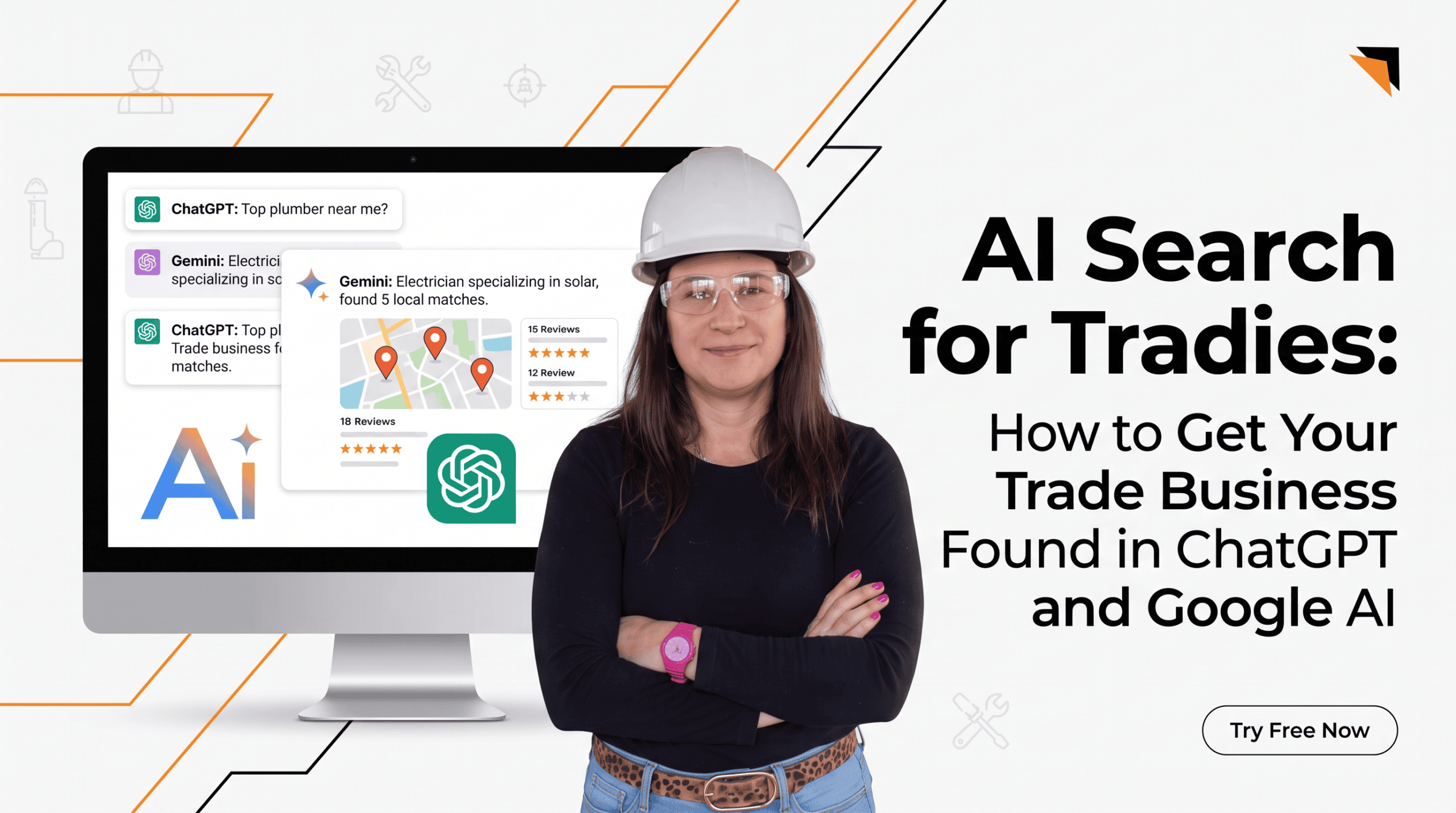
Your next customer might not search Google for “electrician near me.”
They might ask ChatGPT:
“Who is the best commercial electrician in Brisbane?”
Or ask Google:
“Which local plumber specialises in blocked drains and offers emergency call-outs?”
Instead of scrolling through ten different websites, they may receive an AI-generated answer that compares businesses, summarises services and recommends where to look next.
This is AI search.
And if your trade business is invisible inside those answers, you could be missing customers before they ever reach your website.
What Is AI Search?
Traditional Google Search gives someone a list of websites, ads, maps and business listings.
AI search goes a step further.
Platforms like ChatGPT, Google AI Overviews and Google AI Mode can gather information from multiple sources and produce a direct answer to a customer’s question.
That answer may include businesses, websites and links the platform considers relevant and trustworthy.
For established electrical, plumbing, air conditioning, solar, landscaping and other trade businesses, this changes how your business needs to appear online.
It’s no longer only about ranking for:
Electrician Sydney
You also need to provide enough useful information to answer more specific questions such as:
- Who installs commercial switchboards in Western Sydney?
- Which plumber services strata properties on the Northern Beaches?
- What does ducted air conditioning cost for a four-bedroom home?
- Who can install an EV charger at my business?
- Which pool builder services the Central Coast?
- What should I look for when choosing an emergency plumber?
These longer, more detailed searches are exactly where a strong website and useful content can help your business get found.
AI Search Does Not Mean SEO Is Dead
There is already plenty of noise about “AI SEO,” “GEO” and new tricks for getting mentioned by artificial intelligence.
The truth is much less exciting.
Google says the same foundational SEO practices used for traditional search still apply to its AI search experiences.
Your website still needs to be accessible, indexed, technically sound and filled with useful, trustworthy content.
There is no magic piece of code that guarantees your business will appear in an AI answer.
The fundamentals still matter:
- A technically healthy website
- Clear service pages
- Strong location pages
- Helpful, original content
- Customer reviews
- Real project examples
- Accurate business information
- Consistent branding across the internet
- Fast mobile performance
- Content that clearly answers customer questions
AI has changed how information is presented, but it has not removed the need for a properly built website.
AI Needs to Understand Exactly What Your Business Does
Many trade websites are far too vague.
They say things like:
We provide quality workmanship and outstanding service.
That tells an AI search engine almost nothing.
What kind of work do you perform?
Who do you perform it for?
Where do you operate?
What types of projects do you specialise in?
What makes your process different?
A strong trade website should clearly explain:
- Your core services
- The suburbs and regions you service
- The types of customers you work with
- The industries you support
- Your licences, qualifications and partnerships
- The problems you solve
- Your process
- Your completed projects
- The results you have delivered
For example, this is much clearer:
We help strata managers, commercial property owners and facility managers complete electrical maintenance, switchboard upgrades and emergency repairs across Sydney.
That gives both the customer and the search engine useful context.
Your Service Pages Matter More Than Ever
Having one page that lists every service your company provides is no longer enough.
If you want your business to be associated with a particular service, you need a detailed page explaining it.
An established electrical company might need separate pages for:
- Commercial electrical maintenance
- Switchboard upgrades
- Emergency electrical repairs
- Thermal imaging
- EV charger installation
- Data and communications
- Strata electrical services
- Industrial electrical services
Each page should answer the questions a genuine customer would ask before making an enquiry.
That might include:
- Who is the service for?
- What problems does it solve?
- What does the process involve?
- Which locations do you service?
- How quickly can the work begin?
- What affects the price?
- What qualifications are required?
- What happens after someone makes an enquiry?
Clear, focused pages give AI search platforms better information to work with.
Stop Publishing Generic AI-Written Blogs
Using AI to help create content is not the problem.
Publishing hundreds of shallow articles that say exactly the same thing as every other trade website is.
Generic content does not demonstrate experience.
Your business has information that an overseas content writer or an AI writing tool cannot invent:
- Problems your technicians regularly find
- Mistakes you see on jobs
- Pricing factors customers misunderstand
- Before-and-after project results
- Advice based on your local area
- Questions customers ask your team
- Lessons from unusual jobs
- Photos and videos from real projects
- Details about how your company works
That is the information your content should be built around.
AI can help organise, edit and repurpose your knowledge.
It should not replace the knowledge itself.
Real Projects Build Trust
Your completed jobs are one of your strongest AI search assets.
A useful project page could explain:
- The customer’s original problem
- The location and type of property
- What your team discovered
- The solution you recommended
- How the work was completed
- Any complications you managed
- The final result
- Customer feedback
- Photos or videos from the job
This gives customers proof that you do the work you claim to do.
It also creates specific, original information that search engines can connect to your services, locations and expertise.
Instead of publishing another article called “Five Reasons to Hire a Professional Electrician,” show people how your team upgraded the switchboard for a 40-unit apartment complex without disrupting residents.
That is experience.
That is authority.
And that is far harder for a competitor to copy.
Your Google Business Profile Matters Too
Your website isn’t the only place AI and search platforms can learn about your business.
Your Google Business Profile should be kept active and accurate.
That means regularly adding:
- Completed project photos
- Short videos from site
- Before-and-after images
- Service updates
- Helpful posts
- New customer reviews
- Accurate service areas
- Correct opening hours
- Current contact information
If you are already creating reels, project photos and educational content for social media, that content should also be used on your Google Business Profile.
You have already done the hard work to create it.
Put it where customers are actively searching for your services.
Reviews and Online Consistency Still Matter
AI search can use information from across the web to understand your business.
Your company name, services, phone number, location and business details should be consistent across:
- Your website
- Google Business Profile
- Industry directories
- Association listings
- Social media profiles
- Review platforms
- Supplier or partner websites
Your reviews should also contain genuine detail.
A review saying “Great job” is positive.
A review explaining that your team completed a commercial switchboard upgrade on time gives customers and search platforms far more context.
Never script fake reviews.
Instead, ask customers to describe the service they received, the problem your team solved and what they valued about the experience.
Make Sure AI Platforms Can Access Your Website
Your website must be crawlable before it can be considered for search results.
Google needs to be able to access and index your pages.
For ChatGPT search, your website should not block OpenAI’s search crawler, called OAI-SearchBot.
Your website should also include accurate structured data where appropriate.
Structured data helps search engines understand information such as your:
- Business details
- Services
- Locations
- Articles
- Reviews
- Frequently asked questions
This is technical work that happens behind the scenes, but it can make it easier for search platforms to interpret your website correctly.
Being technically eligible does not guarantee inclusion in an AI-generated answer.
It simply ensures your website can be found, understood and considered.
Does AI Search Replace Google Ads?
No.
A customer searching for an emergency electrician, blocked drain plumber or urgent air conditioning repair still has a strong and immediate need.
Google Ads can place your business in front of that customer at the exact moment they are looking for help.
AI search visibility supports another part of the buying journey.
It helps customers research options, understand their problem, compare providers and decide which businesses they trust.
The strongest strategy combines:
Google Ads for immediate demand
SEO for long-term visibility
AI search optimisation for emerging search behaviour
CRM and job management integrations for tracking real revenue
The goal is not simply to appear somewhere online.
The goal is to generate qualified enquiries, turn those enquiries into booked jobs and track which marketing produced the revenue.
Can You Track Leads From AI Search?
Traffic from platforms like ChatGPT can appear as referral traffic in analytics systems such as Google Analytics.
However, AI search reporting is still developing, and not every interaction will be perfectly attributed.
That makes your existing tracking system even more important.
Your website forms, call tracking, CRM and job management platform should work together so you can follow a lead from its original source through to a won job.
For established trade businesses, counting clicks and form submissions is not enough.
You need to know:
- Which channels generated leads
- Which leads were qualified
- Which enquiries became quotes
- Which quotes became jobs
- How much revenue was generated
- What it cost to acquire that revenue
Whether a customer discovers you through Google Ads, organic search, ChatGPT or another platform, your marketing should connect to the final result.
What Should Trade Businesses Do Now?
You do not need to rebuild your entire marketing strategy around AI.
You do need to strengthen the information AI search relies on.
Start by:
- Making your services and locations completely clear.
- Building individual pages for your most valuable services.
- Publishing detailed examples of real projects.
- Answering genuine customer questions.
- Improving your Google Business Profile and reviews.
- Checking that search crawlers can access your website.
- Adding accurate structured data.
- Tracking enquiries through to completed jobs.
- Creating original content based on your team’s experience.
- Continuing to invest in Google Ads and SEO where they produce revenue.
Is Your Trade Business Ready for AI Search?
AI search is changing how customers find and compare trade businesses.
But the companies most likely to benefit are not the ones chasing every new AI trend.
They are the businesses with strong websites, clear services, genuine proof, consistent business information and marketing systems that already work.
If your trade business is already doing $200K+ per month, now is the time to make sure your website, SEO, Google Ads and tracking are ready for what’s next.