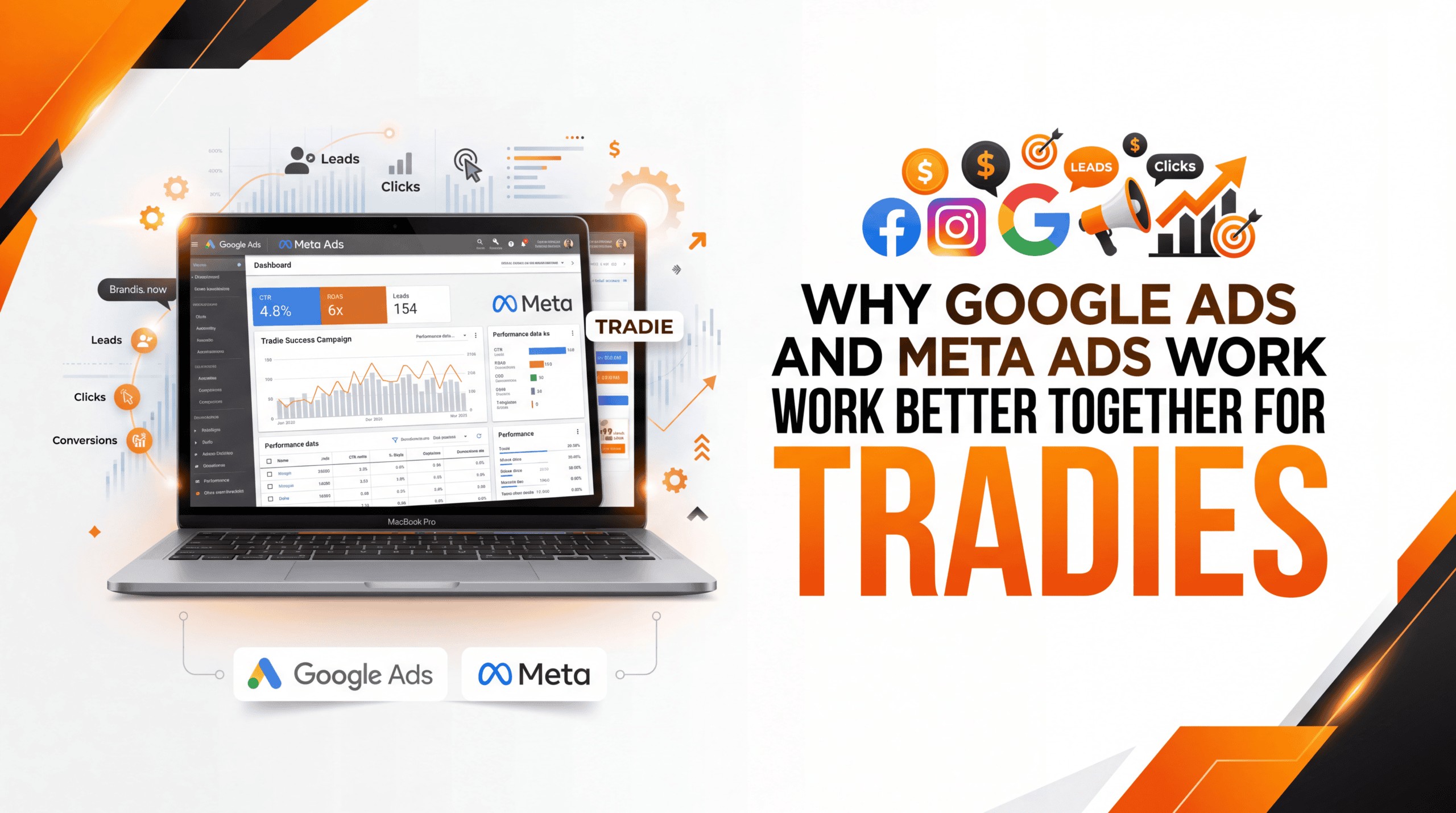
Most trade businesses treat Google Ads and Meta Ads as two completely separate marketing channels.
Google Ads sits in one box.
Facebook and Instagram Ads sit in another.
Different campaigns.
Different reports.
Sometimes even different agencies.
But your customer does not experience your marketing in separate boxes.
They might find you through Google, visit your website, check your reviews, get distracted, open Facebook later, see one of your projects, watch a customer testimonial and then come back to request a quote.
Google can help you capture the initial demand.
Meta can help you stay visible while the customer decides what to do.
That is why Google Ads and Meta Ads can be so powerful when they work together.
GOOGLE CAPTURES THE SEARCH
Google Ads is strongest when someone is actively looking for a service.
They might search:
- Emergency plumber near me
- Electrician North Sydney
- Commercial air conditioning company
- Blocked drain plumber
- Level 2 electrician
- Ducted air conditioning installation
- Hot water replacement
- Commercial electrical maintenance
- Builder for home extension
- Strata plumbing company
There is already intent behind the search.
The person has a problem, a project or a service requirement.
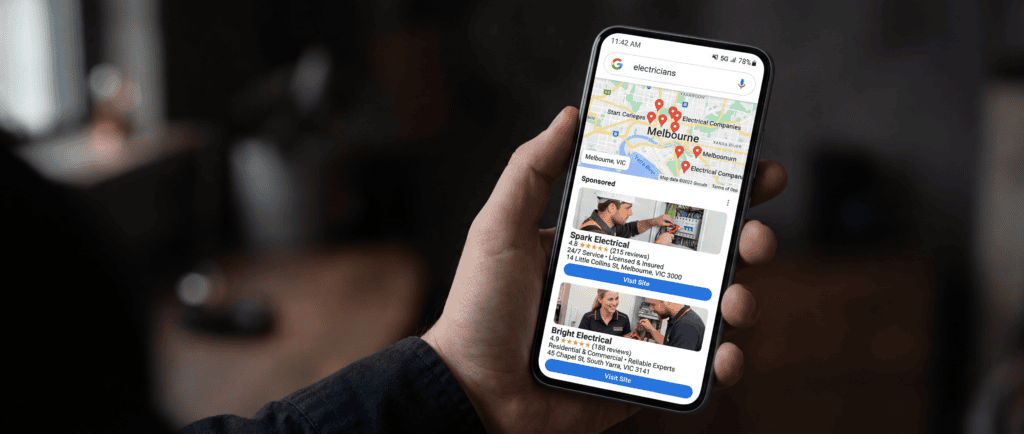
Google Ads gives your business an opportunity to appear at the exact moment they are looking for help.
That is incredibly valuable.
You are not trying to convince a random person that they might need a plumber one day.
You are placing your plumbing business in front of someone who is actively searching for one.
But appearing in the search results does not mean you automatically win the job.
NOT EVERY GOOGLE VISITOR CALLS STRAIGHT AWAY

Some customers will click your Google Ad and call immediately.
This is common with urgent services such as:
- Burst pipes
- Blocked toilets
- Electrical faults
- Power outages
- Failed hot water systems
- Emergency air conditioning repairs
Other customers take longer.
They might be researching:
- A switchboard upgrade
- Ducted air conditioning
- A bathroom renovation
- A commercial maintenance provider
- Solar installation
- An EV charger
- A large drainage project
- A home extension
- A custom building project
They may visit several websites.
They may read reviews.
They may speak with their partner.
They may need approval from a manager.
They may save the job until next month.
They may get interrupted and forget which businesses they looked at.
The original Google click was valuable.
But it was only the beginning of the decision.
META KEEPS YOUR BUSINESS IN FRONT OF THEM
After someone visits your website, Meta Ads can help keep your business visible across Facebook and Instagram.
Instead of disappearing after one website visit, your business can continue showing them:
- Completed projects
- Customer testimonials
- Before and after photos
- Videos of your team
- Helpful explanations
- Common questions
- Case studies
- Service guarantees
- Behind-the-scenes content
- Your experience and accreditations
- The people behind the business
This is often referred to as retargeting or remarketing.
The customer searched on Google.
They visited your website.
Then they started seeing your business on Facebook or Instagram.
To the customer, it can feel like your company is everywhere.
That repeated visibility helps build familiarity and trust.
GOOGLE FINDS THEM WHEN THEY NEED YOU
META REMINDS THEM WHY THEY SHOULD CHOOSE YOU
Google and Meta play different roles.
Google is usually strongest at capturing existing demand.
The customer already knows they need something.
Meta is strong at keeping your business visible, building trust and helping people remember you.
Think of it like this:
Google says: “We provide the service you are searching for.”
Meta says: “Here is why you can trust us to do it.”
Used together, the channels support more of the customer journey.
AN EXAMPLE FOR A PLUMBING BUSINESS
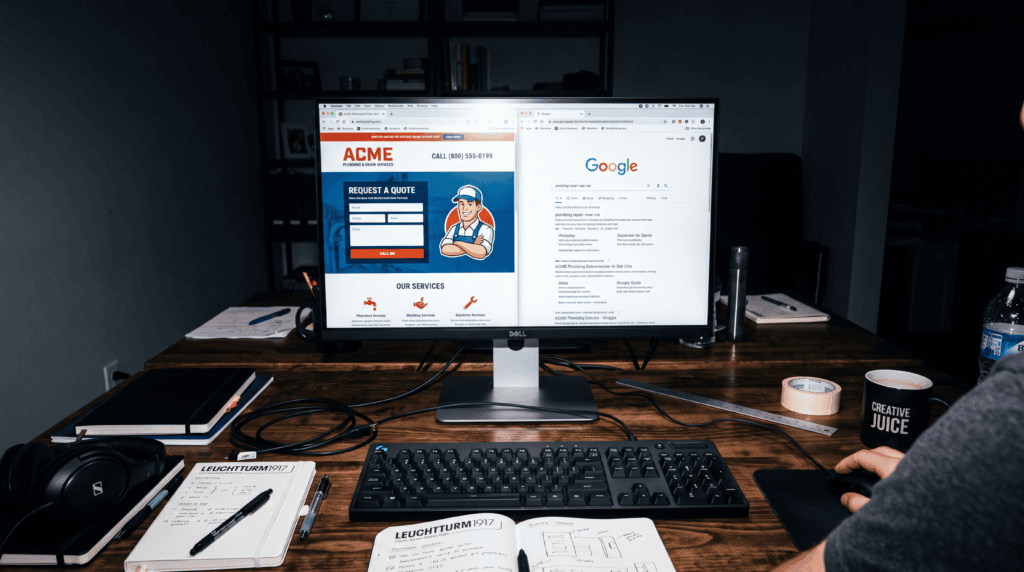
Imagine a homeowner searches:
Hot water replacement Sydney
They click your Google Ad.
They land on a dedicated hot water page and look at:
- The systems you install
- Customer reviews
- Your service area
- Your team
- The quote process
They do not call.
Maybe they are at work.
Maybe they want to talk to their partner.
Maybe the existing system is still limping along.
That evening, they open Facebook and see a short video from your business:
Three signs your hot water system is about to fail
The next day, they see a customer testimonial about a recent hot water replacement.
Two days later, they see a photo of your branded vehicle and plumbing team completing another installation.
When the old system finally stops working, which plumbing business are they likely to remember?
The one they clicked once and forgot?
Or the one they have now seen several times?
AN EXAMPLE FOR A COMMERCIAL ELECTRICAL COMPANY
A facility manager searches:
Commercial electrician Sydney
They click an ad and visit your commercial electrical page.
They are not necessarily ready to call.
They may be researching possible contractors before an upcoming tender or maintenance review.
Over the next few weeks, they see Meta Ads showing:
- A commercial lighting upgrade
- A maintenance case study
- A video explaining emergency response
- Your technicians working in a large facility
- A testimonial from another commercial client
- Your safety systems and accreditations
By the time they are ready to create a shortlist, your business is familiar.
They have seen your capability.
They recognise the brand.
You are no longer a completely unknown company from a Google search.
WHY ONE GOOGLE CLICK IS OFTEN NOT ENOUGH
A Google click can be expensive.
If you have paid to get someone onto the website, it makes sense to get more value from that visit.
Without follow-up advertising, the customer may leave and never see your business again.
They might forget the name.
They might click a competitor.
They might postpone the job.
They might remember the business whose vans they see locally or whose videos keep appearing online.
Meta gives you another opportunity to continue the relationship after the original click.
You are not repeatedly asking the person to buy with the same advertisement.
You are answering the questions and doubts that may have stopped them from enquiring.
META ADS SHOULD DO MORE THAN SAY CALL NOW
A poor retargeting campaign shows the customer the same generic ad every day:
Need a plumber? Call now.
They already know you are a plumber.
They visited the website.
The next advertisements should help them decide whether you are the right plumber.
Use Meta retargeting to answer questions such as:
- Can I trust this company?
- Have they completed work like mine?
- Do they work in my area?
- Are they established?
- What will the process be?
- Who will turn up?
- Do other customers recommend them?
- Will they communicate properly?
- Can they handle the size of the job?
- What makes them different?
This is where your content becomes important.
WHAT SHOULD TRADIES SHOW IN META RETARGETING ADS?
CUSTOMER REVIEWS
Show real feedback from customers who used the service.
CASE STUDIES
Explain the customer’s problem, what your team did and the result.
BEFORE AND AFTERS
Let people see the quality of the work.
TEAM VIDEOS
Introduce the people who answer the phone, quote the work and arrive on site.
EDUCATIONAL VIDEOS
Answer common questions customers ask before booking.
PROJECT WALKTHROUGHS
Show the size and type of work your team can handle.
SERVICE EXPLANATIONS
Explain how the process works and what happens after someone enquires.
TRUST SIGNALS
Show licences, industry memberships, accreditations, warranties and years of experience.
BRANDED VEHICLES
Help customers recognise the company locally.
COMMON PROBLEMS
Create content around the specific problems your best customers experience.
This content makes the business feel real.
GOOGLE ADS CAN CAPTURE THE LEAD
META CAN HELP CONVERT THE LEAD
Meta should not only retarget anonymous website visitors.
It can also support people who have already enquired but have not booked.
For example, someone might:
- Submit a quote request
- Speak with the office
- Receive an estimate
- Book an inspection
- Receive a formal quote
- Delay making a decision
While they are deciding, they can continue seeing content from your business.
This is particularly useful for services with longer buying cycles, such as:
- Air conditioning installations
- Solar
- Electrical upgrades
- Bathroom renovations
- Home renovations
- Custom building
- Commercial maintenance
- Large drainage work
- Civil projects
Google generated the original opportunity.
Meta helps keep the business visible while the sales process continues.
RETARGETING IS NOT A REPLACEMENT FOR FOLLOW-UP
Seeing an ad on Facebook does not replace calling the customer.
Your team still needs a proper follow-up process.
That might include:
- Calling after the initial enquiry
- Sending appointment confirmations
- Following up after a site visit
- Checking whether the quote was received
- Answering questions
- Following up unaccepted quotes
- Recording why opportunities were lost
Meta Ads support that process.
They do not remove the need for it.
A customer may ignore an email but remember the company after seeing a helpful video that evening.
Then, when your office calls again, the business feels more familiar.
META CAN ALSO CREATE NEW DEMAND
Google is excellent when customers already know what they need.
Meta can put a service in front of someone before they actively search for it.
For example:
- A homeowner may not realise their old switchboard should be upgraded.
- A property manager may not be actively searching for a new maintenance plumber.
- A business owner may not know how much an air conditioning upgrade could reduce breakdowns.
- A homeowner may have been thinking about an EV charger without searching for an installer.
- A family may have discussed a renovation without choosing a builder.
Meta content can introduce the problem, explain the opportunity and create interest.
When that person eventually searches Google, they may search for your business by name.
So the relationship can work in both directions.
Google brings new people into your world.
Meta follows up and builds trust.
Meta introduces your business.
Google captures the person when they are ready to take action.
WHY BRAND SEARCHES MATTER
After seeing your Meta Ads, a customer may not click the advertisement directly.
They might open Google and search your business name.
They may look for:
- Reviews
- Your website
- Your Google Business Profile
- Your address
- Your phone number
- Project examples
- Complaints
- Social profiles
This is another reason the channels should not be judged in isolation.
Meta may help create familiarity.
Google may receive the final search and conversion.
If you only look at which platform recorded the last click, you can miss how the channels influenced each other.
YOUR WEBSITE CONNECTS THE TWO CHANNELS
Your website is the centre of the system.
Google Ads sends high-intent traffic to it.
Meta can bring previous visitors back.
The website needs to:
- Explain the service
- Build trust
- Show proof
- Make contact easy
- Track enquiries
- Load quickly
- Work properly on mobile
- Send customers to the right next step
If the website is weak, both channels suffer.
You can run excellent ads and still lose the customer after the click.
YOU NEED THE RIGHT TRACKING IN PLACE
To make Google and Meta work together, the tracking needs to be properly configured.
The business should be able to understand:
- Which campaign generated the first website visit
- Which pages the customer viewed
- Whether they returned
- Whether they called
- Whether they submitted a form
- Whether the enquiry was qualified
- Whether a quote was sent
- Whether the job was booked
- What the job was worth
Privacy settings, consent requirements and platform rules need to be handled correctly.
The objective is not to follow individual people around the internet in a creepy way.
The objective is to use permitted audience and campaign data to keep the business visible and measure whether the marketing creates genuine opportunities.
DO NOT SHOW THE SAME AD FOREVER
Retargeting becomes annoying when a customer sees the same advertisement constantly.
Your Meta campaign should use a mix of content.
For example:
AD 1: CUSTOMER PROBLEM
Explain a common issue.
AD 2: PROJECT PROOF
Show your team solving that issue.
AD 3: CUSTOMER REVIEW
Share what the customer said.
AD 4: TEAM INTRODUCTION
Show who will complete the work.
AD 5: PROCESS
Explain what happens after someone enquires.
AD 6: CALL TO ACTION
Invite the customer to book, call or request a quote.
The campaign should feel like a useful introduction to the business.
Not the same salesperson shouting at the customer every day.
SEPARATE YOUR AUDIENCES
Not every website visitor should see the same ads.
Where possible, audiences can be separated based on the type of content or service they viewed.
For example:
- Plumbing visitors
- Electrical visitors
- Commercial service visitors
- Hot water visitors
- Air conditioning visitors
- Renovation visitors
- People who started but did not submit a form
- People who enquired but have not booked
- Past customers
- Existing customers who should be excluded from acquisition ads
Someone who viewed a blocked drain page should not spend the next month seeing ads about ducted air conditioning.
Relevance matters.
HOW MUCH SHOULD A TRADE BUSINESS SPEND?
The right budget depends on the size of the business, service area, customer value and growth goals.
At TradiesGO, we generally recommend a minimum Google Ads budget of $100 per day for an established trade business.
Google is normally where the larger share of the budget goes when the immediate goal is capturing active search demand.
A separate Meta budget can then be used to:
- Retarget website visitors
- Build trust
- Promote proof
- Re-engage potential customers
- Create awareness
- Support longer sales cycles
The exact split should be based on the opportunity.
A plumbing company focused on urgent repairs may invest more heavily in Google.
A builder selling large renovations may need a stronger Meta content and retargeting strategy because customers take longer to decide.
There is no universal budget split that suits every trade.
HOW DO YOU MEASURE WHETHER IT IS WORKING?
Do not judge the strategy only by Facebook likes or Google clicks.
Measure the business outcomes.
Look at:
- Website visitors
- Returning visitors
- Phone calls
- Form submissions
- Qualified leads
- Quote requests
- Quotes sent
- Jobs booked
- Cost per qualified lead
- Cost per booked job
- Revenue generated
- Return on advertising spend
- Branded Google searches
- Assisted conversions
- Sales cycle length
You should also ask new customers:
How did you hear about us?
Their answer may be:
“I saw you on Google, then you kept popping up on Facebook.”
That is the system working.
COMMON MISTAKES TO AVOID
RUNNING GOOGLE ADS WITHOUT RETARGETING
You pay to bring people to the website, then disappear when they leave.
RUNNING META ADS WITHOUT A CLEAR OFFER
The content gets attention but does not connect to a service or next step.
USING GENERIC STOCK CONTENT
Customers want to see the actual business, team and work.
SENDING EVERYONE TO THE HOMEPAGE
Each service should have a relevant destination.
ONLY RUNNING SALES ADS
Customers need proof and trust, not constant calls to buy.
NOT FOLLOWING UP LEADS
Retargeting cannot repair a sales process that ignores enquiries.
MEASURING EACH PLATFORM IN ISOLATION
The customer may interact with both before converting.
FAILING TO EXCLUDE THE WRONG AUDIENCES
Existing customers, job seekers or irrelevant visitors may not belong in every campaign.
HAVING BROKEN TRACKING
If calls, forms and jobs are not recorded, you cannot see what is working.
WHAT THE COMPLETE CUSTOMER JOURNEY LOOKS LIKE
A connected Google and Meta strategy can look like this:
- A customer searches for a trade service on Google.
- They see your Google Ad.
- They click through to a relevant landing page.
- They read about the service and view your proof.
- They leave without enquiring.
- They later see your business on Facebook or Instagram.
- They watch a project video.
- They see a customer testimonial.
- They recognise your team and brand.
- They return to Google or the website.
- They call or submit an enquiry.
- Your office qualifies the lead.
- Your team sends a quote.
- The customer continues seeing relevant proof while deciding.
- Your office follows up.
- The job is booked.
- The revenue is connected back to the marketing.
That is much stronger than hoping one ad and one website visit will do everything.
GOOGLE CREATES THE OPPORTUNITY
META BUILDS THE FAMILIARITY
Google Ads and Meta Ads should not be fighting over which platform gets credit.
They should have different jobs inside the same growth strategy.
Google helps your business appear when someone is actively searching.
Meta keeps your business visible while that person compares, delays and decides.
Google creates the opportunity.
Meta helps build the trust.
Your website converts the interest.
Your office team follows up.
Your CRM or field service software records the result.
Together, they create a stronger customer acquisition system.
WANT GOOGLE AND META WORKING TOGETHER?
TradiesGO builds connected marketing strategies for established electricians, plumbers, HVAC companies, builders and other trade businesses.
We help connect:
- Google Ads
- Meta Ads
- Landing pages
- Call tracking
- Lead follow-up
- ServiceM8, simPRO and other field service systems
- Booked jobs and revenue reporting
The goal is not to collect clicks from one platform and views from another.
The goal is to generate qualified opportunities, follow them through the decision process and understand what the marketing produced.
If you are ready to build a marketing system that does more than wait for the phone to ring, let’s talk.