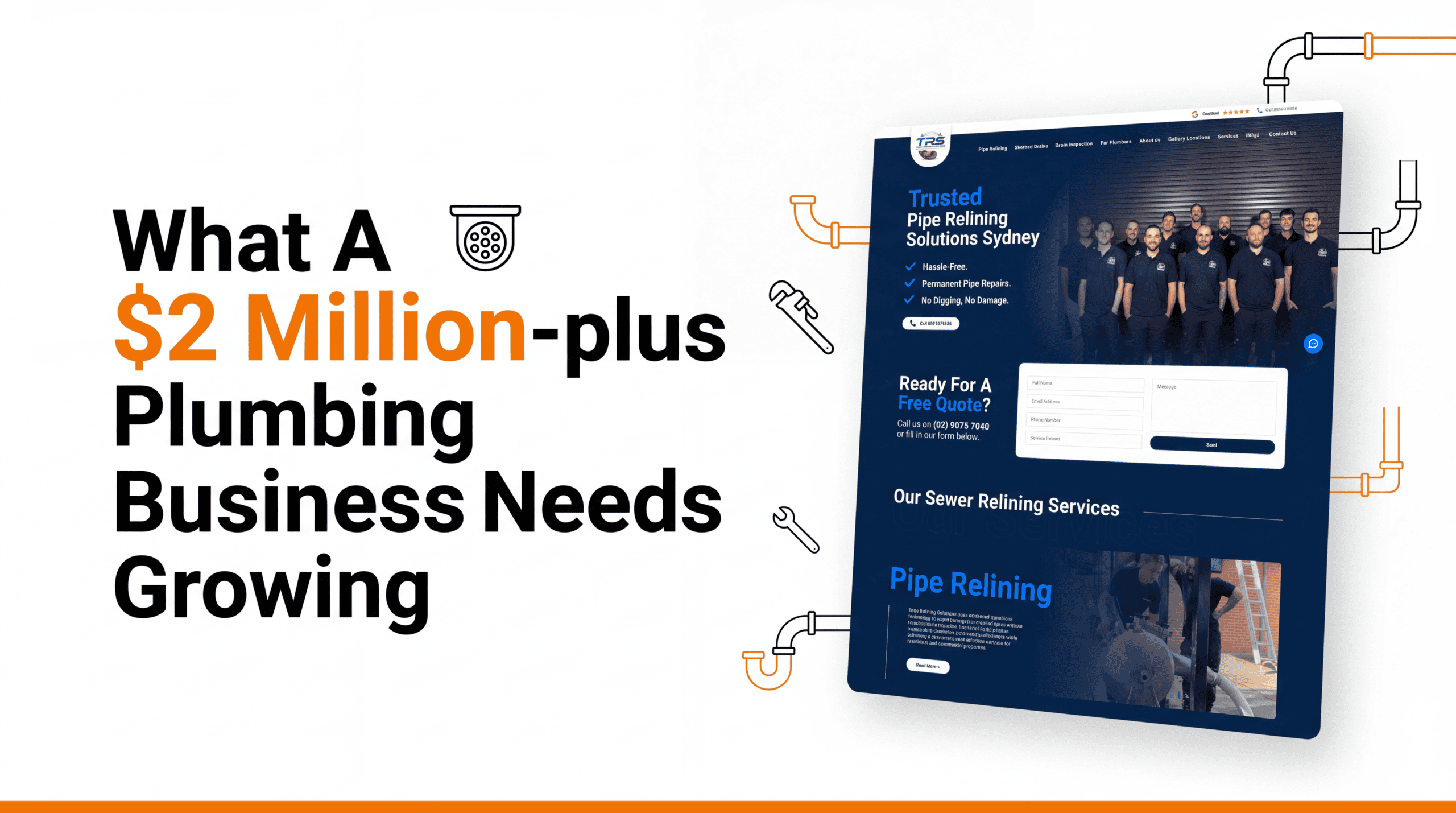
Getting a plumbing business to $2 million in annual revenue is a serious achievement.
You have moved beyond being a plumber with a few helpers.
You likely have multiple vehicles on the road, plumbers and apprentices in the field, an office team, software subscriptions, suppliers, equipment and a significant wage bill.
There is real momentum inside the business.
There is also more risk.
At this size, a quiet week hurts.
A few empty job boards hurt.
Poor-performing technicians hurt.
Missed calls hurt.
Unprofitable work hurts.
A marketing campaign that generates the wrong leads can waste thousands of dollars and hours of your team’s time.
The systems that helped you reach your first $1 million will not necessarily take you through $2 million, $5 million or $10 million.
A $2 million-plus plumbing business needs structure.
It needs visibility.
And it needs a consistent way to turn marketing into enquiries, enquiries into booked jobs and booked jobs into profitable revenue.
Here are the essential foundations an established Australian plumbing business needs to keep growing.
1. A CLEAR PLAN FOR THE WORK YOU WANT
At $2 million-plus, “we do all plumbing” is not a growth strategy.
Your business may be capable of completing:
- Blocked drains
- Emergency plumbing
- Hot water repairs
- Hot water replacements
- Leak detection
- Gas fitting
- Bathroom renovations
- Strata maintenance
- Commercial maintenance
- Civil plumbing
- Drainage
- New builds
- Insurance work
- Real estate maintenance
But that does not mean every service is equally valuable.
Some jobs produce strong margins.
Some lead to repeat work.
Some are easy to schedule.
Some require specialist equipment.
Some consume an entire day and produce very little profit.
Some attract customers you do not want.
The business needs clarity around:
- The services you want more of
- The services you want less of
- Your most profitable work
- Your best customer types
- The areas you want to dominate
- The work that creates repeat revenue
- The jobs that keep the team productive
- The services you can scale without the owner becoming the bottleneck
Without this clarity, the marketing team promotes everything.
The call centre books everything.
The plumbers complete everything.
Then the owner wonders why revenue is growing but profit is not.
2. A CONSISTENT LEAD PIPELINE
A $2 million plumbing business cannot rely entirely on referrals.
Referrals are valuable.
They are also difficult to control.
You do not know exactly when the next referral will arrive, which service they will need or whether your team will have capacity at the right time.
An established plumbing business needs a predictable mix of lead sources.
This could include:
- Google Ads
- Search engine optimisation
- Google Business Profile
- Repeat customers
- Email and SMS marketing
- Commercial relationships
- Real estate and strata partnerships
- Referral partners
- Local area marketing
- Social proof and online content
The objective is not to be everywhere for the sake of it.
The objective is to avoid being dangerously dependent on one source of work.
If one real estate agreement ends, the phones should not stop.
If Google changes, the business should not disappear.
If referrals slow down, the job board should not empty.
A strong plumbing business builds several reliable pathways for customers to find and choose it.
3. A REALISTIC GOOGLE ADS BUDGET

An established plumbing business should not expect to dominate a competitive area with a $20 daily Google Ads budget.
At TradiesGO, we generally recommend a minimum advertising budget of $100 per day for an established trade business.
For a $2 million-plus plumbing company operating across a larger service area, the appropriate budget may be higher.
The right figure depends on:
- Your service area
- Local competition
- The services being promoted
- Search demand
- Average cost per click
- Your team’s capacity
- Average job value
- Lead-to-job conversion rate
- Growth targets
The campaign should also be focused.
Do not spread the budget across every possible plumbing service and suburb.
Start with the work the business wants and has the capacity to deliver.
You may decide to focus on:
- Blocked drains
- Hot water systems
- Emergency plumbing
- Commercial maintenance
- Strata plumbing
- Leak detection
Each service has a different customer, urgency, job value and sales process.
The advertising strategy needs to reflect those differences.
4. A WEBSITE BUILT TO GENERATE WORK
At $2 million in revenue, your website should not look like it was built by a mate ten years ago.
Customers use the website to decide whether your company is established, trustworthy and capable.
The site needs to clearly communicate:
- What services you provide
- Where you operate
- Who you work with
- Why customers should choose you
- How to contact the team
- What happens after they enquire
It should include:
- Individual service pages
- Clear service areas
- Click-to-call buttons
- Simple enquiry forms
- Customer reviews
- Real team photos
- Branded vehicle photos
- Project examples
- Licence and accreditation details
- Commercial capability
- Emergency availability where relevant
- Clear calls to action
A larger plumbing business also needs different pathways for different customers.
A homeowner with a burst pipe needs a fast way to call.
A facility manager may want to understand your commercial capability.
A strata manager may need evidence of communication, reporting and ongoing support.
One generic page cannot properly sell every service to every customer.
5. DEDICATED LANDING PAGES FOR IMPORTANT SERVICES
Sending every Google Ads visitor to the homepage is rarely the strongest strategy.
A customer searching for a blocked drain plumber should land on a blocked drain page.
A commercial property manager should land on a commercial plumbing page.
A homeowner looking for a hot water replacement should see information about hot water systems, installation and the next step.
Dedicated landing pages make the journey clearer.
They can be built around:
- One service
- One customer type
- One problem
- One location
- One clear action
A strong landing page should answer:
- Do you provide the service I searched for?
- Do you work in my area?
- Can I trust your company?
- Do you have experience with this problem?
- What should I do next?
- What happens after I contact you?
The easier those answers are to find, the easier it is for the customer to enquire.
6. CALL TRACKING

Plumbing businesses receive a significant number of leads by phone.
If calls are not tracked properly, the business has an incomplete picture of marketing performance.
Call tracking should help identify:
- Where the caller came from
- Which campaign generated the call
- Which service they searched for
- Whether the call was answered
- How long the call lasted
- Whether it was a new lead
- Whether the enquiry was qualified
- Whether the lead became a job
Without call tracking, a business may turn off a profitable campaign because the leads were never recorded.
It may also continue spending on a campaign that generates supplier calls, job seekers, existing customers and irrelevant enquiries.
The number of calls alone is not enough.
You need to understand the quality and outcome of those calls.
7. SOMEONE WHO OWNS THE PHONE
A $2 million plumbing business cannot treat incoming calls casually.
Every missed call may represent advertising spend and potential revenue.
The business needs clear responsibility for:
- Answering calls
- Returning missed calls
- Responding to forms
- Qualifying enquiries
- Booking jobs
- Following up quotes
- Recording lead sources
- Updating customer records
If everyone is responsible, nobody is responsible.
The person answering should also know how to handle a new lead.
They need to ask:
- What work is required?
- Where is the property?
- How urgent is the problem?
- Is it residential, commercial or strata?
- Who is responsible for approving the work?
- Has another plumber attended?
- What is the best next step?
The first phone conversation can determine whether the business wins or loses the job.
8. A FAST LEAD RESPONSE PROCESS
Customers do not always contact one plumbing business and wait patiently.
They may call several.
They may submit multiple forms.
They may choose the first company that answers confidently and makes the next step easy.
Your lead response process should define:
- How quickly calls are answered
- What happens when a call is missed
- How soon online enquiries receive a response
- Who follows up unbooked leads
- How after-hours enquiries are handled
- How urgent and non-urgent jobs are separated
- How commercial opportunities are escalated
- When follow-up stops
This should not depend on whether the owner notices a message.
It should be built into the business.
9. A FIELD SERVICE SYSTEM THAT IS ACTUALLY USED
Platforms such as ServiceM8, simPRO, ServiceTitan and AroFlo can create valuable visibility across the business.
But buying the software is not the same as implementing it.
The system needs clean and consistent data.
Your team should know how to record:
- Lead source
- Job type
- Customer type
- Service location
- Assigned technician
- Quote status
- Job status
- Invoice value
- Payment status
- Follow-up requirements
If every team member enters information differently, reporting becomes unreliable.
The field service system should help the business answer:
- How many new leads did we receive?
- Which channels generated them?
- Which jobs were quoted?
- Which quotes were accepted?
- Which technicians generated additional work?
- Which services produced the most revenue?
- How long did jobs take?
- Which customers are overdue?
- Which marketing generated profitable jobs?
The software should provide visibility.
It should not become an expensive digital filing cabinet.
10. MARKETING CONNECTED TO BOOKED JOBS AND REVENUE
Many plumbing businesses know how much they spend on marketing.
Far fewer can clearly connect that spend to booked jobs and revenue.
A report might say:
- 600 website clicks
- 80 conversions
- 50 phone calls
- 30 forms
- $90 cost per lead
But what happened next?
How many were genuine plumbing enquiries?
How many were inside the service area?
How many were quoted?
How many booked?
What services did they buy?
What revenue did they generate?
A $2 million-plus business needs to connect the marketing data with what happens inside the CRM or field service software.
The reporting should follow the full journey:
Marketing source → Lead → Qualified opportunity → Quote → Booked job → Completed job → Revenue
This allows the business to compare:
- Cost per lead
- Cost per qualified lead
- Cost per quote
- Cost per booked job
- Revenue by channel
- Revenue by service
- Revenue by suburb
- Return on advertising spend
That is the difference between reporting marketing activity and understanding marketing performance.
11. A PROPER QUOTE FOLLOW-UP SYSTEM
Plumbing businesses can spend thousands generating leads and preparing quotes, then leave the quote sitting in the customer’s inbox.
No call.
No SMS.
No reminder.
No follow-up.
The business assumes the customer went elsewhere.
But the customer might simply be:
- Busy
- Waiting for another person’s approval
- Comparing options
- Unsure about the next step
- Waiting for payday
- Distracted
- Concerned about part of the quote
A follow-up process should define:
- When the first follow-up happens
- Whether the customer receives an SMS
- Who calls them
- How many follow-ups occur
- What questions should be asked
- How lost quotes are recorded
- What reason the customer gives for not proceeding
The objective is not to harass people.
It is to make sure valuable opportunities do not disappear because nobody followed up.
12. CLEAR NUMBERS
Revenue alone can hide problems.
A plumbing company can produce $2 million in sales and still have weak cash flow, inconsistent margins and an exhausted owner.
The business needs visibility over numbers such as:
- Revenue
- Gross profit
- Net profit
- Labour cost
- Material cost
- Average job value
- Revenue per technician
- Billable hours
- Callback rate
- Quote conversion rate
- Cost per lead
- Cost per booked job
- Debtor days
- Marketing return
The owner does not need to stare at 100 numbers every morning.
But the leadership team should agree on the handful of numbers that show whether the business is healthy.
What gets measured can be investigated and improved.
13. PRICING THAT COVERS THE REAL COST OF DELIVERY

A growing plumbing business has more costs than wages and materials.
Pricing needs to account for:
- Vehicles
- Fuel
- Insurance
- Software
- Office wages
- Warehousing
- Equipment
- Training
- Supervision
- Marketing
- Finance costs
- Callbacks
- Unbillable time
- Management
- Profit
If prices were created when the business had two plumbers and the owner answered every call, they may no longer support a larger operation.
Revenue can rise while margin disappears.
The business needs to understand the real cost of putting a qualified plumber and equipped vehicle on the road.
14. CAPACITY PLANNING
Generating more leads is not always the immediate answer.
First, understand the capacity of the team.
Ask:
- How many jobs can we complete each day?
- Which technicians can handle which work?
- Are particular days consistently quiet?
- Are we overbooked in the mornings and empty in the afternoons?
- How far are technicians travelling?
- Are jobs allocated by skill and location?
- Do we have capacity for emergency work?
- Are commercial jobs disrupting the residential schedule?
- Is the owner still required on too many jobs?
Marketing should be connected to capacity.
If the hot water team has room, promote hot water.
If blocked drains are overflowing the schedule, do not keep increasing the blocked drain budget without a plan.
If the commercial division needs work, build a campaign around commercial opportunities.
The marketing should help fill the right gaps.
15. TECHNICIAN PERFORMANCE VISIBILITY

Technicians do more than complete tasks.
They influence:
- Customer satisfaction
- Reviews
- Repeat work
- Average job value
- Quote conversion
- Referrals
- Callback rates
- Brand reputation
The business needs a fair way to understand performance.
This might include:
- Jobs completed
- Revenue produced
- Average job value
- Billable utilisation
- Quote opportunities identified
- Customer reviews
- Callback rate
- Paperwork quality
- Payment collection
- Customer communication
This is not about pressuring plumbers to sell work customers do not need.
It is about making sure technicians can recognise legitimate problems, explain options clearly and provide a professional customer experience.
16. A REVIEW-GENERATION PROCESS

Reviews are a major trust signal for plumbing customers.
The business should not rely on staff remembering to ask occasionally.
Build a consistent process.
The best time to request a review is normally after a positive customer experience, when the work has been completed and the customer is satisfied.
The process might include:
- A technician asking in person
- An automated SMS
- An email with a direct link
- A follow-up reminder
- Monitoring and responding to reviews
- Escalating unhappy customers before requesting a review
Reviews support:
- Google Business Profile visibility
- Google Ads conversion
- Website trust
- Sales conversations
- Commercial credibility
- Recruitment
A steady flow of recent, genuine reviews is more valuable than a sudden burst followed by silence.
17. A DATABASE THAT IS USED
A $2 million plumbing business has likely built a valuable customer database.
Past customers already know the company.
Many will need plumbing services again.
The database can support campaigns involving:
- Hot water servicing
- Preventative maintenance
- Drain cleaning
- Gas appliance checks
- Commercial maintenance reminders
- Seasonal offers
- Property manager communication
- Customer reactivation
The business should segment its database rather than sending the same message to everyone.
A residential homeowner should not receive the same email as a facility manager.
Your existing database may contain some of the easiest revenue opportunities in the business.
18. COMMERCIAL AND RECURRING REVENUE
Reactive residential plumbing can produce strong demand.
But recurring commercial, strata and maintenance work can add stability.
A larger plumbing business should understand what proportion of revenue comes from:
- One-off residential work
- Emergency work
- Property management
- Strata
- Commercial maintenance
- Construction
- Insurance
- Recurring agreements
The right mix depends on the business.
The goal is not to chase commercial work purely because it sounds bigger.
Commercial work can involve longer sales cycles, more administration, tighter payment terms and different margins.
The business needs a deliberate strategy for winning and servicing it profitably.
19. A BRAND PEOPLE RECOGNISE
At $2 million-plus, the business should not look interchangeable with every other plumber.
A strong brand is more than a logo.
It is the complete experience customers have with the company.
That includes:
- The website
- Vehicles
- Uniforms
- Phone manner
- Quotes
- Emails
- Job reminders
- Technician presentation
- On-site communication
- Reviews
- Social content
- Follow-up
- Invoices
A recognisable, consistent brand builds trust before the customer calls.
It can also improve recruitment and support better pricing.
20. A RECRUITMENT PIPELINE
Growth requires people.
Waiting until the team is overloaded before posting a job advertisement can create months of pressure.
A larger plumbing business should be building its employer brand before it urgently needs another plumber.
That might include showing:
- The team
- The type of work
- Training opportunities
- Equipment and vehicles
- Career progression
- Company culture
- Leadership
- Employee achievements
- What makes the workplace different
Your marketing is not only seen by customers.
Potential employees are looking too.
21. AN OWNER WHO IS NOT THE ENTIRE SYSTEM
A $2 million plumbing business can still be completely dependent on its owner.
The owner may still:
- Approve every quote
- Solve every technical problem
- Handle major complaints
- Check every invoice
- Manage the plumbers
- Review all marketing
- Answer after-hours calls
- Win every commercial account
- Make every important decision
That creates a ceiling.
The business cannot scale beyond the owner’s available time and energy.
The next stage requires:
- Clear roles
- Delegated authority
- Documented processes
- Capable managers
- Reliable reporting
- Regular meetings
- Accountability
- Leadership development
The owner should have visibility without needing to personally touch every job.
22. A WEEKLY SCORECARD
The leadership team should be able to see what happened in the business without waiting until the end of the month.
A simple weekly scorecard could include:
- New leads
- Qualified leads
- Calls answered
- Calls missed
- Jobs booked
- Quotes sent
- Quotes accepted
- Revenue booked
- Revenue completed
- Average job value
- Google Ads spend
- Cost per qualified lead
- Cost per booked job
- Technician capacity
- Outstanding invoices
- Customer reviews
The exact numbers will vary.
What matters is having one agreed source of truth.
The scorecard should make problems visible early.
23. A MONTHLY MARKETING REVIEW CONNECTED TO OPERATIONS
Marketing should not sit in a separate universe from the business.
The marketing team needs to know:
- Which services need more work
- Which areas have capacity
- Which jobs are profitable
- Which leads are poor quality
- Which campaigns generate booked work
- Which locations create travel problems
- Which technicians have availability
- Whether calls are being answered
- Whether quotes are being followed up
The operations team also needs to understand what marketing is doing.
A proper monthly review should connect advertising, lead handling, job capacity, sales and revenue.
This helps stop situations where the agency celebrates a low cost per lead while the plumbing team complains that the enquiries are rubbish.
24. A PLAN FOR THE NEXT STAGE
What does the next stage actually look like?
Is the goal:
- $3 million?
- $5 million?
- A second location?
- More commercial maintenance?
- A stronger management team?
- Higher profit without more revenue?
- An owner who no longer works on the tools?
- A business that can eventually be sold?
The answer changes the strategy.
Growing from $2 million to $4 million is not simply a matter of buying twice as many leads.
The business may need:
- More technicians
- More vehicles
- More office support
- Better dispatch
- Stronger management
- More working capital
- Better reporting
- A recruitment pipeline
- More profitable service lines
- A stronger brand
- A larger marketing investment
The destination needs to be clear before the business accelerates.
THE ESSENTIAL SYSTEM FOR A $2 MILLION-PLUS PLUMBING BUSINESS
A larger plumbing business needs more than good plumbers and a busy phone.
It needs a connected system.
Marketing creates demand.
The office converts demand into booked work.
Operations deliver the work efficiently.
The field service system records what happened.
The numbers show what was profitable.
That information guides the next marketing and business decision.
When these areas work together, growth becomes more predictable.
When they are disconnected, the business can feel busy while leaking profit everywhere.
IS YOUR MARKETING BUILT FOR THE SIZE OF YOUR PLUMBING BUSINESS?
TradiesGO works with established trade businesses that have moved beyond the start-up stage.
We understand that a $2 million-plus plumbing company does not need a few random leads.
It needs:
- Consistent demand
- Better-quality opportunities
- Clear lead tracking
- Strong landing pages
- Google Ads built around profitable services
- Visibility from click to booked job
- Marketing connected to ServiceM8, simPRO or your field service system
- Reporting that shows what the marketing actually produced
If your plumbing business is already doing more than $2 million a year and you are ready to build a more predictable lead and revenue system, let’s talk.